Showing posts with label Brahma. Show all posts

Wednesday, 27 March 2013

Control Kaama and Eliminate Holika, Dhundhi and Pootana - Message of Holi

What do Holika, Dhundhi, Pootana and Kaama Deva have in common?

Well, one festival which connects all these is the festival of colors, Holi.

In this post we will look at all the legends associated with Holi.

1. Holika

The most ‘popular’ event associated with Hoil is the burning of the demoness Holika. Infact the name ‘Holi’ is a shortened version of the name ‘Holika’.

Legend has it that there was a great king of Asuras called Hiranyakashipu. He pleased Lord Brahma with severe tapasya and got a boon that he could not be killed 'during day or night; inside the home or outside, not on earth or in the sky; neither by a man nor an animal; neither by astra nor by shastra'. He became so self obsessed that he forbid worship of any God and in fact declared himself as the ‘Master of one and all’. But such is Prabhu’s maya that his own son Prahlada turned out to be a great devotee of Lord Vishnu.

[caption id="attachment_699" align="aligncenter" width="254"]Hiranyakashyipu threatening Prahlad to stop worshiping Lord Vishnu Hiranyakashyipu threatening Prahlad to stop worshiping Lord Vishnu[/caption]

Hiranyakashipu couldn’t digest the fact that his own blood was going against his wishes. After trying very hard to pursue Prahlad to stop worship of Vishnu, Hiranyakashyapu reached a stage where he thought that killing his son was the only solution to end this ‘revolt’.

[caption id="attachment_700" align="aligncenter" width="300"]Prahlad locked up with snakes Prahlad locked up with snakes[/caption]

He poisoned Prahlada; but the poison got converted to nectar in his mouth.

He ordered Prahlada to be trampled by elephants; but Prahlada remained unharmed.

He put Prahlada in a room with hungry, poisonous snakes; no damage was done to Prahlada.

He threw Prahlada down a cliff; Prahlada easily survived the fall.

Thus all of Hiranyakashipu's attempts to kill his son failed.

Finally, he decided to employ the services of his demoness sister Holika in order to ensure the killing of Prahlad.

Prahlad was made to sit on a pyre in the lap of Holika.

Now the logic behind this was that Holika had a boon that she couldn’t be burned by fire.

So the plan was to make Prahlada burn while Holika would be unaffected by the fire. Prahlada quietly went and sat on Holika’s lap. The only thing he constantly did was to take the name of the Almighty - 'Om Namo Narayana'.

[caption id="attachment_696" align="aligncenter" width="300"]Holika gets burnt in the fire and Prahlad remains unharmed Holika gets burnt in the fire and Prahlad remains unharmed[/caption]

When the pyre was lit, much against the expectations of people around, Holika  was affected by the heat of the fire and slowly her body perished. On the other hand Prahlad was untouched and unaffected by the fire.

This event is known as Holika Dahan.

[caption id="attachment_697" align="aligncenter" width="194"]Holika Dahan, on the eve of Holi Holika Dahan, on the eve of Holi[/caption]

Even today bonfires are lit on the eve of the Holi festival to commemorate Holika Dahan.


2. Dhundhi

In the kingdom of Prithu there was an ogress called Dhundhi.

Now Dhundhi, had a boon from Lord Shiva that she could not be killed by Gods, men nor suffer either from arms or from heat, cold or rain. These boons made her almost invincible. but there was a catch. She was also cursed by Lord Shiva that she would be in danger from young boys.

Because of this Dhundhi used to trouble little children in particular.

Prithu was alarmed by this terror of Dhundhi. He consulted a lot of people and a solution was arrived at. It was decided that on last full moon day of Phalguna, when the season of cold vanishes and summer begins, young boys with bits of wood in their hands would go out of their houses, collect a heap of wood and grass, set it on fire with mantras, clap their hands, go around the fire thrice, laugh, sing and by their noise and laughter Dhundhi would die.

The plan worked and since that day Holi is celebrated at the end of the winter season on the last full moon day of the lunar month Phalguna.


3. Pootana

This legend is about Pootana. Pootana was summoned by Kansa, ruler of the Vrishni kingdom to kill Krishna, his nephew, as it was foretold to Kansa that Devki's 8th son i.e. Sri Krishna would kill him.

Just like Hiranyakashipu had tried numerous times to kill Prahlad, Kansa also made a lot of attempts to kill Krishna.

One such attempt was through Pootana. Kansa called Pootana and ordered her to go down to Gokul immediately. Pootana assumed the disguise of a young beautiful woman and entered Krihsna’s home town. Somehow she managed to distract all the women of the town and while they were away from their babies Putana made the babies suck her breast which had been smeared with poison. Thus slowly and slowly all the new born babies of Gokul died. Finally when Pootana came into Nand and Yashoda’s house and made Krishna suck her breast, she was in for a surprise. Krishna squeezed her breasts and sucked her milk as well as her life.

[caption id="attachment_701" align="aligncenter" width="300"]Pootana's life sucked by Krishna Pootana's life sucked by Krishna[/caption]

Pootana couldn't bear the pain and went back to her real demonic form. She ran out of the house with Krishna still clinging to her. When the people of Gokul arrived at the place where Pootana fell, they were stunned to see small Krishna still alive and the dangerous Pootana dead.

The people of Gokul were releived that no harm had been done to Krishna and decided to hold a special celebration. Since then this celebration has become a part of the many legends associated with Holi.

This legend is particularly famous in the state of Goa.


4. Kaama Deva

Sati and Lord Shiva were happily married to each other. Once Sati’s father Daksha organised a yagya, but did not invite Sati or Shiva as he had an altercation with Shiva in the court of Brahma. But, Sati who wanted to attend the yagya, went even though Lord Shiva did not appreciate the idea. To here great anguish, Daksha ignored her presence and did not even offer a place for Shiva. Sati felt humiliated and was struck with profound grief. She jumped into the yagna fire and immolated herself.

Lord Shiva became extremely furious when he heard the news of Sati’s immolation. Carrying the body of Sati, Shiva began to perform Rudra Tandava (dance of destruction) and wiped out the kingdom of Daksha. Everybody was terrified as Shiva’s Tandava had the power to destroy the entire universe. In order to calm Lord Shiva, Vishnu severed Sati's body into 12 pieces and threw them on earth. It is said that wherever the pieces of Shakti’s body fell, there emerged a Shakti Peetha.

Lord Siva undertook rigorous penance and retired to the Himalayas. Sati took a re-birth as Parvati in the family of God Himalaya. She also started performing penance to break Shiva’s meditation and win his attention.

During this time a demon by the name of Tarkasur terrorized the Devtas and became the ruler of the world. Tarkasur had a boon that he could be only killed by the son of Lord Shiva.

[caption id="attachment_704" align="aligncenter" width="300"]Shiva opening Third-eye and turning Kaama Deva into ashes Shiva opening Third-eye and turning Kaama Deva into ashes[/caption]

As Shiva was paying no heed to Parvati's tapasya, the Devtas requested Kaama Deva (also known as Madan) to accelerate the process of bringing together Shiva and Parvati. So Kamadeva shot his love-arrow on Shiva's heart. A deeply disturbed Lord Shiva opened his third eye and the fury of his third eye instantly turned Kamadeva into ashes. Kaama Deva's wife Rati requested Shiva  to restore her husband's life. Shiva agreed to Rati's request and granted immortality to Kamdev, but added that Kaamdeva would exist in a disembodied (free from a body) form. Since this day Kamadeva is also known as 'Ananga' or 'Atanu' (both meaning 'without body').

This event is celebrated as Kaama Dahan in southern parts of India.


Thus we see that Holi might be given any name, but the essence and message of Holi remains the same - eliminate and burn the negativities inside us (just like Holika, Dhundhi, Pootana and Kaama Deva were burnt) and lead a positive and colorful life.

Wishing all of you a very Happy Holi :)


Sunday, 17 February 2013

How Sage Vashishtha brought down River Gomti on Earth

There is an interesting tale describing how sage Vashishtha had brought down Gomti from the heaven to earth.

At the time of deluge when the whole world had submerged in water, a lotus flower manifested from Lord Vishnu's navel on which was seated Brahma. Lord Vishnu instructed him to perform his duty as a creator to which Brahma agreed.

First of all Brahma created his manasputras and sought their help in increasing the population of the world by becoming householders. But, all of them were extremely virtuous and did not show any inclination towards getting married.

Ultimately all of them went to the western coast and engaged themselves in austere penance. Their penance continued for a number of years after which 'Sudarshan Chakra' appeared before them. As all of them looked up in bewilderment, they heard a heavenly voice - "O sons of Brahma! Very soon the almighty Vishnu is going to manifest himself. The 'Chakra' you are seeing is his. You all must perform the rituals of 'ardhya' in the name of Lord Vishnu to show your reverence towards him."

All the Manasputras eulogized Sudarshan-Chakra with deep devotion. All of them wished that there were a holy river, with whose water they could perform the rituals of ardhya. But to their utter dismay there was no such holy river nearby. They then remembered Lord Brahma, who immediately understood what they desired.

Lord Brahma instructed Ganga by saying - "Ganga! Go to the earth, where you would be known as Gomti. Sage Vashishth will lead you to your destination. Just follow him like a daughter follows her father."

Finally, when sage Vashishth followed by Gomti reached their destination, all the Manasputras were delighted. They eulogized Ganga and expressed their gratitude to Vashishth for bringing Ganga on earth.

All of them thanked Vashishth by saying - "Since you have brought Gomti on earth, you would be considered as her father."

They offered 'ardhya' to Gomti and subsequently eulogized Lord Vishnu. Lord Vishnu appeared after being pleased and blessed them - "Your unflinching devotion in me has pleased me no bound. Since you did this penance with the objective of Moksha (salvation), this place would become famous as Moksha Dayak (giver of salvation). This sacrosanct place would also be called Chakra teerth because of Sudarshan chakra, who informed you all of my manifestation on earth. I assure you that I won't abandon this sacrosanct place even for a moment."

This way, all the Manasputras were finally successful in their objective of offering ardhya to Lord Vishnu with the holy water of Gomti. At last, Gomti having fulfilled her mission for which she had descended down to Earth merged with the ocean. Lord Vishnu disappeared from there and Manasputras continued to live there.


Thursday, 17 January 2013

How Rishi Durvasa's curse resulted in the 'Greatest Show on Earth - The Kumbh Mela'!

Rishi Durvasa holds a special place in the many lores of Hindu mythology.

To begin with he was the ‘avatar’ of Lord Shiva born to Atri and Anasuya.

He was extremely feared for his short temper. He didn’t think twice before giving a shraap (curse) to anyone who didn't please him.

[caption id="attachment_577" align="aligncenter" width="218"]Durvasa cursing Shakuntala Durvasa cursing Shakuntala[/caption]

Right from Ambaraisha to Shakuntala and even Lakshman ‘suffered’ due to his curse. (more on these stories later)

But the one person who was one of his earliest ‘victims’ and whose attempts to get back to what he had lost resulted in a series of events due to which millions of followers come together once in 12 years to wash away all their sins.

The individual I am talking about is Indra and it is the Kumbh Mela which resulted from curse Sage Durvasa had given Indra.

Let’s know more about this story today.

[caption id="attachment_578" align="aligncenter" width="300"]Vidyadhari giving the garland to Durvasa Vidyadhari giving the garland to Durvasa[/caption]

Once Durvasa was wandering on earth, when he came across a female Vidyadhari (a nymph of the air) who was wearing a beautiful garland of flowers. Seeing Durvasa being attracted to the garland the nymph respectfully gave it to the sage. When he came back from earth, the sage came across Indra riding his elephant, Airavata.

[caption id="attachment_579" align="aligncenter" width="300"]Indra riding on the Airavata Indra riding on Airavata[/caption]

Durvasa presented the garland to Indra, who not sure of what to do with the garland placed it on Airavata's head. The elephant was irritated by the fragrance of the nectar in the flowers and threw the garland to the ground with its trunk and crushed it with his feet. Durvasa was enraged to see his gift treated so callously and immediately cursed Indra that he would be cast down from his position of dominion over the three worlds, just as the garland was cast down.

Indra immediately begged Durvasa's forgiveness, but the sage refused to retract or even soften his curse, and went on his way.

Because of the curse, Indra and the Devas were diminished in strength and shorn of their lustre. Seizing this opportunity, the Asuras led by Bali waged war against the gods. The Devtas were routed and turned to Brahma for help.

Brahma in turn directed them to seek refuge with Vishnu. Vishnu in turn gave the idea for the Samudra Manthan.

Stay tuned; the story becomes very interesting from here ;)

Monday, 17 December 2012

What roles do Shiva's Lingam, Ketaki flower, Sage Bhrigu and Daityas play in Brahmajee not being worshipped?

One of the most intriguing questions pertaining to Hindu mythology is that why Lord Brahma is not worshipped as much as the other two Lords in the holy trinity? Why does Brahma have a handful of temples dedicated to him while Vishnu and Shiva have infinite?

Let’s find out all the legends associated with this ‘mystery’!

1. brahma-vishnu-shiva-According to the Shiv Purana, once Brahma and Vishnu had an argument on who was the most powerful amongst the Trimurti. The argument became so heated that the other gods asked Shiva, the third of the triad, to intervene. Shiva assumed the form of a gigantic lingam (the phallic symbol of Shiva). The lingam was of flaming fire and it went up to the heavens and descended into the nether regions underneath the earth. Both Brahma and Vishnu agreed that the one who finds out how enormous the fiery lingam was and where it ended will be considered the most powerful among the Trimurti.

Brahma took the form of a swan and went upwards along the length of the ascending lingam while Vishnu assumed the form of a boar and descended along the lingam into the nether regions.

Both went on and on but neither could reach the ends.

Vishnu, being very clever, realized that he had been outdone by Shiva and came back to acknowledge Shiva as the greatest of the triad.

[caption id="attachment_397" align="aligncenter" width="300"]ketaki Ketaki Flower[/caption]

Brahma, on the other hand, decided that he could get past Shiva with trickery. On his ascent to determine the end of the upper part of the lingam, Brahma passed the ketaki flower (Pandanus odorifer). Brahma requested ketaki to testify before Shiva that he had reached the uppermost end to which the flower agreed. When brought before Shiva, the flower told Shiva that he had observed Brahma reach the upper end of the lingam.


Lingam-Shiva-Brahma-VishnuShiva immediately found out about the lie and became very angry. He cursed Brahma with the horror of not ever being worshipped on earth. Also the ketaki flower was cursed with the depressing condition of never ever being used in any Hindu worshiping rituals.

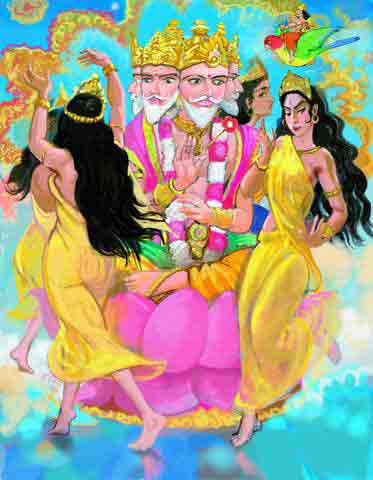
2. Brahma headsAccording to the Matsya Purana, Shatarupa was known by different names, including Satarupa, Sarasvati, Sandhya or Brahmi.

When Brahma was creating the universe, he made a female deity known as Shatarupa (she of a hundred beautiful forms).

Brahma was immediately infatuated by the goddess's beauty and unable to contain his passion (kaam) pursued her wherever she went. Shatarupa did not want to be associated with carnal desire and moved in various directions to avoid his gaze but wherever she went, Brahma developed another head until he had four, one for each direction of the compass. Desperate, Shatarupa leaped over him to stay out of his gaze even for a moment. A fifth head, however, appeared above the others. Thus, Brahma developed five heads.
At this moment Shiva appeared, cut off the top head and determined that since Shatarupa was Brahma's daughter (being created by him), it was wrong and incestous of Brahma to become obsessed with her. He directed that there be no proper worship in India for the "unholy" Brahma. Thus, only the other two Gods of the Trimurti, Vishnu and Shiva continue to be worshipped, while Brahma is almost totally ignored. Ever since the incident, Brahma has been reciting the four Vedas, one from every mouth, in his attempt at repentance.

Another version of the story describes how all of the animals of all kinds in today's world were born. After Brahma had grown his fifth head Shatarupa had turned into a cow to avoid his lust. When Brahma found out he turned into a bull in order to continue to follow Shatarupa, eventually finding her. She hid in the form of another animal in order to quell his unnatural lust. But, alas, Brahma found out again and incarnated as the appropriate male animal. Again, she hid in the form of another animal. This continued until and Shiva finally ripped off one of Brahma's five heads to put an end to his lust.

[caption id="attachment_400" align="aligncenter" width="300"]Bhrigu and Brahma Sage Bhrigu in Brahma Lok[/caption]

3. Once upon a time many great sages gathered at the bank of river Saraswati to participate in Maha yagya organized at that time. Maharishi Bhrigu was also present there. All the great saints and sages could not decide that out of the Trimurti - Lord Vishnu, Brahma and Shiv who is pre-eminent and to whom should they offer Pradhanta (Master) of that yagya. With the consent of all the great saints present there, it was decided that Maharishi Bhrigu will test and decide who was pre-eminent.


Upon being entrusted with the task Maharishi Bhrigu decided to test Lord Brahma first. He went on to see Lord Brahma in Brahmalok. On reaching Brahmalok Maharishi displayed utter disrespect to Lord Brahma on purpose. Lord Brahma got angry as Bhrigu was his son and wanted to punish Maharishi but Maha Saraswati, wife of Lord Brahma saved Maharishi from his anger (in some versions he himself composed himself to hide the anger). Angry with disrespect and not finding bRahma worth of being ‘Supreme’ Maharishi Bhrigu cursed Lord Brahma that no one will worship Brahma in Kaliyug.

In another version Brahmarshi Bhrigu cursed Brahma because when he went to Brahma to invite him for a Yagna he was deeply immersed in the music played by Saraswati and couldn't hear Bhrigu's calls.

4. According to the Bhavishya Purana certain 'daityas' or demons had begun to worship Brahma and therefore the 'devas' of heaven could not defeat them. In order to mislead the daityas from the worship of Brahma, Vishnu appeared on Earth, as Buddha and Mahavira. With various arguments he convinced the daityas to leave the worship of Brahma. Having left the worship of Brahma, the daityas lost power and were hence defeated.

In the next post we see what was Step 3 for Lord Brahma in the creation of the world.

Brahmajee’s Step 3 – The Prajapatis

PrajapatisAfter the initial setbacks, Brahma was more than ever determined to create further. This resulted in the following 10 creations from Brahma’s body and mind -

  1. Marici - from his mind

  2. Atri - from his eyes

  3. Angira - from his mouth

  4. Pulastya - from his ears

  5. Pulaha - from his navel

  6. Kratu - from his hand

  7. Bhrigu - from his touch

  8. Vasistha - from his life-air

  9. Daksha - from his thumb

  10. Narada - from his lap


All of them are also known as the 'Prajapatis'.

Brahma didn’t stop here and carried on with following creations -

  1. Dharma (religion) - from the right side of his breast

  2. Adharma (irreligion) - from his back

  3. Kaam (lust) - from his heart

  4. Krodh (anger) - from his eyebrows

  5. Lobh (greed) - from his lower lip

  6. Saraswati - from his mouth

  7. Samudra (oceans) - from his penis

  8. Nir-riti (reservoir of all vices) - from his anus


In addition to all this Kardama Muni manifested from his shadow.

But after all these activities an untoward incident took place and Brahma had to leave his body.

What made Brahma dessert his body and seek penance? And more importantly why is Brahma not worshipped as much Vishnu and Shiva? Why a handful of temples dedicated to Brahma whereas infinite temples and places dedicated to the other two individuals of the Trimurti?

Answer to all these questions in the next post.

Friday, 14 December 2012

Brahma's Step 2 - The Rudras create havoc

Before the Kumaras, Lord Brahma first created the five forms of agyaan (ignorance) :

1)    andhatamisra - the idea that one would die
2)    tamisra - indignation
3)    maha-moha - craving of infatuation
4)    moha - delusion of errors
5)    tamas  - absence of knowledge about one's own engagements

Seeing such a misleading creation as a sinful task, Brahma did not feel much pleasure in his activity, and therefore he purified himself by further meditation. Then he began another term of creation.

This resulted in the creation of the four Kumaras - Sanaka, Sananda, Sanatana and Sanat-kumara.

But when these four refused to generate progeny, anger (krodh) was generated in the mind of Brahma.

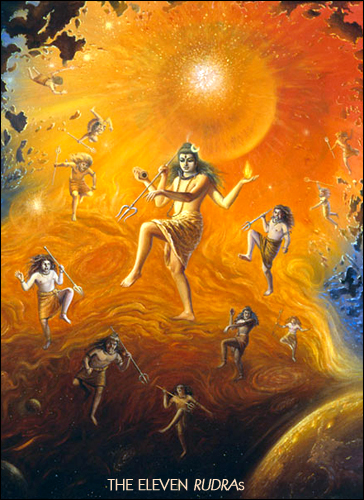
Although he tried to curb his anger, out of his anger from between his eyebrows instantly a child who was red (for passion) and blue (for ignorance) was born.

The child cried loudly to his ‘father’ and requested him to designate him a name and a place.

“As you were crying out aloud the moment you were born, people will address you with the name Rudra”, Brahma pacified the child by first giving him a name.
Rudras
“The heart, the senses, the air of life, the sky, the air, the fire, the water, the earth, the sun, the moon and austerity are places for your residence”.

Manyu, Manu, Mahinasa, Mahan, Siva, Ṛtadhvaja, Ugrareta, Bhava, Kala, Vamadeva and Dhrtavrata are your 11 other names”

Dhi, Dhrti, Rasala, Uma, Niyut, Sarpi, Ila, Ambika, Iravati, Svadha and Diksa are your eleven wives (the Rudranis).”

“You are the master of the living beings. Accept these different names and places and the wives belonging to them and increase the population on a large scale” Brahma asked Rudra.

Rudra generated unlimited sons and grandsons. All of them assembled together and attempted to devour the entire universe. When Brahma saw this he became afraid of the situation and requested Rudra to stop generating living entities of this destructive nature.

He advised his son Rudra to undergo penance which would result in creation of the universe as it was before.

Rudra took leave from his father and started performing austere penances.

Thus the second attempt also didn't yield desired dividends for Brahma.

Monday, 10 December 2012

Lord Brahma's Step 1 – The ‘Four Kumaras’ or the ‘Catursana’

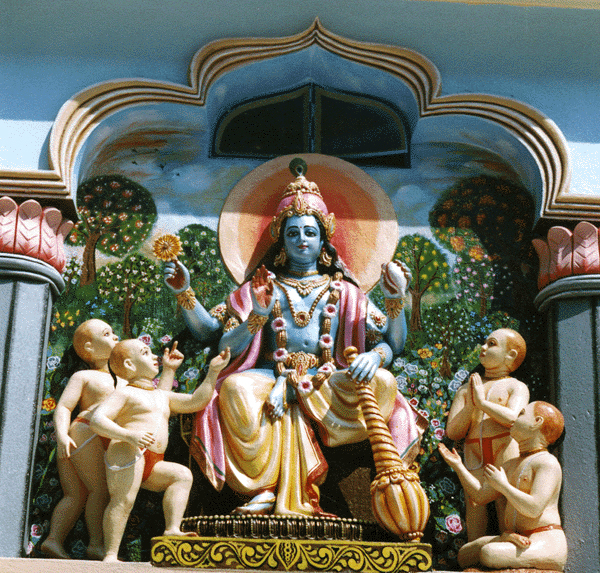
The Four KumarasAt the beginning of the process of creation, Lord Brahma created the ‘Four Kumaras’ or the ‘Catursana’.

As the Four Kumaras were born from the mind (manas) of Brahma they are referred to as his Manasaputras.

Their names are : Sanaka, Sanandana, Sanatana and Sanat Kumara.

When the four Kumaras came into existence, they were all embodiments of pure qualities. They did not have any sign of negative qualities like laziness, sleep etc.

Now Lord Brahma had created these four Kumaras so that they could help in the process of creation.

However, the Kumaras (kumara means unmarried) refused his order to procreate and instead devoted themselves to God and celibacy (brahmacarya).

They requested their father for the boon of remaining perpetually five years old.

The Four Kumaras are mentioned numerous times in the Puranas as well as the Upanisads.

1. According to a verse in the Srimad Bhagavatam (6.3.20-21)

svayambhur naradah sambhuh
kumarah kapilo manuh
prahlado janako bhismo
balir vaiyasakir vayam
dvadasaite vijanimo
dharmam bhagavatam bhatah
guhyam visuddham durbodham
yam jnatvamrtam asnute


Kumaras


Meaning - "Lord Brahma, Bhagavan Narada, Lord Siva, the Four Kumaras, Lord Kapila, Svayambhuva Manu, Prahlada , Janaka Maharaja, Grandfather Bhishma, Bali Maharaja, Sukadeva Gosvami and I myself know the real religious principle."

2. In the 11th Canto of the Bhagavata Purana Lord Sri Krishna in His conversation with Uddhava declares:

                                                                                        etavan yoga adisto macchisyaih sanakadibhih 

Meaning – "I taught this yoga to my disciples, the four brothers headed by Sanaka."

3. According to a verse in the Padma Puraṇa,

sampradāyavihīnā ye mantrāste niṣphalā matāḥ|
ataḥ kalau bhaviśyanti catvāraḥ sampradāyinaḥ||
Śrī-brahmā-rudra-sanakā vaiṣṇavā kṣitipāvanāḥ|
catvāraste kalau bhāvya hyutkale puruṣottamāt||
rāmānujaṃ śrī svicakre madhvācaryaṃ caturmukhaḥ|
śrīviṣṇusvāminaṃ rudro nimbādityaṃ catuḥsanāḥ||


Meaning - All mantras which have been given (to disciples) not in an authorised Sampradāya are fruitless. Therefore, in Kali Yuga, there will be four bona-fide Sampradāyas. Each of them were ignaugurated by Śrī Devī and known as the Śrī Sampradāya, Lord Brahmā and known as the Brahmā Sampradāya,Lord Rudra and known as the Rudra Sampradāya; and the Four Kumāras and known as Sanakādi Sampradāya. Śrī Devī made Rāmānujācārya the head of that lineage. So too Lord Brahmā appointed Madhvācārya, Lord Rudra appointed Viṣṇusvāmī and the four Kumaras chose Nimbāditya (an epithet for Śrī Nimbārkācārya).

The Nimbarka Sampradaya also known as the Hamsa Sampradaya, Kumara Sampradaya, Catuḥ Sana Sampradaya and Sanakadi Sampradaya, is one of the four ‘authorised’ Vaiṣṇava Sampradāyas.

4. According to a story from the Bhagavata Purana, the Four Kumaras once visited Vaikuntha, the abode of Vishnu, to see him.

Due to the boon from their father Brahma and the strength of their tapas, the Four Kumaras lloked like 5 year olds. Jaya and Vijaya, the gate keepers of the Vaikuntha stopped the Kumaras at the gate, thinking them to be children. They told the Kumaras that Sri Vishnu is resting and that they cannot see him now. The enraged Kumaras cursed both Jaya and Vijaya, that they would have to give up their divinity, be born as mortals on Earth (bhuloka), and live like normal human beings.
This curse was eventually 'diluted' to Jay and Vijaya choosing to be born three times on Earth as enemies of Vishnu. (more on this in another post later)

5.                                                                               Nārāyaṇamukhambhojānmantrastvaṣṭādaśākṣaraḥ|
                                                                                          Āvirbhūtaḥ kumāraistu gṛhītvā nāradāya ca||

This holy eighteen-syllabled mantra known as Śrī Gopāla Mantra was given by Lord Vishnu to the Four Kumaras and was in turn passed to the disciple of the Kumaras, Narada Muni.

This mantra is the Vaidika mantra from the Gopalatapinyupaniṣad of the Atharva Veda.

Narada MuniNarada Muni took initiation from his elder brothers, the Kumaras and their discussions as guru and disciple are recorded in the Upaniṣads with a famous conversation in the Chandogya Upaniṣad.

6. Prithu and Four KumarasThe dialogue between King Prithu and the Four Kumaras found in the Bhagvata Purana in which the Kumaras preached Prithu about devotion to Vishnu is one of the finest writings on bhakti.


Thus we see that the first attempt by Brahma to increase the population on earth failed.

What was his next step?

Find out in the next post.

Sunday, 2 December 2012

Progenitor of all human beings - Lord Brahma

One of the foremost concepts in Hinduism is that of the Trimurti.
brahma_vishnu_shiva[1]
According to this concept, the ‘functions’ of creation, maintenance, and destruction are performed by the following

1) Brahma - the creator
2) Vishnu - the maintainer or preserver
3) Shiva - the destroyer or transformer

This trio is often addressed as "Brahma-Vishnu-Maheshwara".

But one out of these three is conspicuous by absence (or very limited presence) in the numerous temples all over the world is the 'progenitor or great grandsire of all human beings' - Lord Brahma. (post on this later)
Brahma is the great great grandfather of Manu and from Manu all human beings are descended.

There are numerous legends about the origins of Lord Brahma.

Hiranyagarbha

1) According to Manu Smriti and the Shatapatha Brahmana, Brahma emerged from Brahman, the Supreme Being. Brahman wanted to create the universe. He first created water into which he deposited his seed. This seed became a golden egg, and from this egg, he was born as Brahma or Hiranyagarbha (born of the golden egg)

Brahma Vishnu

2) According to Vaishnavism, Brahma arose from a 1,000-petalled lotus that grew out of Vishnu's navel.

3) According to a few Puranas, Brahma is the son of the Supreme Being and his female energy Maya.

Different legends give different versions of the origins of Brahma. But the only constant factor is the fact that all the legends maintain that it was Brahma who is incharge of ‘creation’.

Starting this post we start on a journey in which we will gradually unravel Brahma’s creations and try and find out about our ‘forefathers’.

Let's seek the blessings of the 'srishti rachayta' before embarking on this mission.

Brahma

Om Brang Brahmaneya Namaha